Face Procedure 08 · Rhinoplasty

Rhinoplasty in Dubai

The nose sits at the centre of the face, so millimetres matter and so does the rest of your face. Good rhinoplasty is planned in proportion to your chin, brow and profile — never in isolation.

Board-Certified Surgeons

DHA-licensed surgical facility

Whole-Profile Planning

Chin, brow and profile assessed together

Breathing Assessed

Function corrected in the same operation

Natural-Looking Results

Refinement, not a template nose

In Short

Rhinoplasty reshapes the bone and cartilage of the nose to change its size, profile, tip or width, and can correct breathing obstruction at the same time. Closed rhinoplasty works entirely through incisions inside the nostrils; open rhinoplasty adds a small incision across the columella for greater visibility. Swelling settles substantially within weeks but the final refined result takes twelve to eighteen months to appear.

Anaesthetic
General
Procedure time
2–4 hours
Hospital stay
Day case or 1 night
Back to work
7–10 days
Splint removed
7 days
Final result
12–18 months

The Procedure

What Is Rhinoplasty?

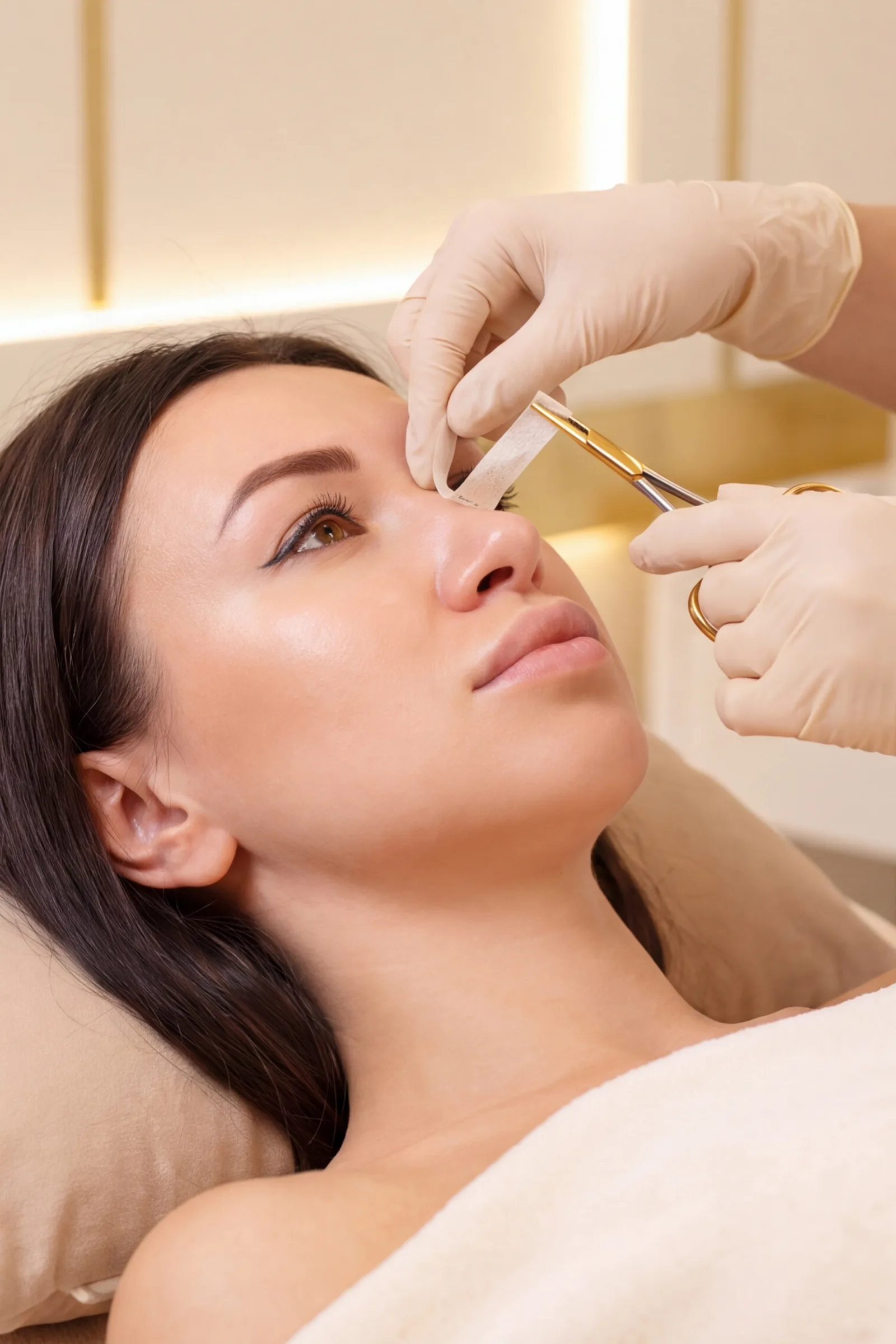
Rhinoplasty reshapes the underlying framework of the nose — bone in the upper third, cartilage in the lower two thirds — and allows the skin to redrape over the new structure. That last point explains a great deal about outcomes: thick skin redrapes slowly and conceals fine detail, while thin skin reveals every irregularity beneath it.

The other thing that separates good rhinoplasty from adequate rhinoplasty is that the nose is never assessed alone. A dorsal hump can look prominent because the nose is large, or because the chin is recessive and the profile is unbalanced. Reducing the nose in the second case produces a smaller nose on a face that still looks unbalanced. Elora assesses the profile as a whole.

Function is assessed alongside appearance as a matter of routine. Many patients with a cosmetic concern also have a deviated septum or narrowed valves affecting their breathing, and both can be addressed in the same operation. Reducing a nose without accounting for the airway can leave someone looking better and breathing worse.
Techniques & Options

Your Rhinoplasty Options

01

Closed Rhinoplasty

All incisions are placed inside the nostrils, leaving no external scar and generally producing less swelling and faster settling. It suits cases where the required changes are well defined and do not demand extensive tip reconstruction.

02

Open Rhinoplasty

A small incision across the columella — the strip of skin between the nostrils — allows the skin to be lifted for direct visibility of the entire framework. It is preferred for complex tip work, significant asymmetry and revision cases; the scar typically becomes very difficult to see.

03

Preservation & Structural Techniques

Preservation rhinoplasty reshapes the dorsum while keeping its natural contour intact rather than removing and rebuilding it. Structural techniques use cartilage grafts to support and define the framework, which is often essential in revision surgery and thicker-skinned noses.

Candidacy

Is Rhinoplasty Right for You?

You are likely a good candidate if

  • Facial growth complete — generally seventeen and above
  • Specific, describable concerns about shape, profile or breathing
  • In good general health and a non-smoker
  • Realistic expectations about what nasal anatomy allows
  • Prepared for a twelve to eighteen month settling period

This may not be the right procedure if

  • Facial growth still incomplete
  • Expectation of an exact replica of another person's nose
  • Unaddressed body dysmorphic concerns, which need psychological assessment first
  • Unwilling to accept the long settling period, particularly in thicker skin
  • Active nasal infection or uncontrolled inflammatory nasal conditions

How Rhinoplasty Is Performed, Step by Step

1

01

Facial and Nasal Analysis

Your nose is assessed in the context of your whole profile — chin projection, brow position, facial thirds and skin thickness, all of which constrain what is achievable.

2

02

Functional Assessment

The septum, internal and external valves and turbinates are examined, since breathing obstruction can be corrected during the same procedure.

3

03

Planning and Simulation

Goals are discussed against your specific anatomy. Where imaging simulation is used, it is a communication tool for agreeing direction, not a promise of outcome.

4

04

Surgery

Under general anaesthetic, the framework is reshaped through closed or open access — bone refined, cartilage reshaped, grafts placed where support or definition is required.

5

05

Splinting

An external splint protects the reshaped framework for approximately seven days. Internal splints are used where septal work has been performed.

6

06

Staged Settling

Most visible swelling resolves within weeks, but the tip is the last area to refine and continues changing for a full twelve to eighteen months.

Techniques Compared

Open Versus Closed Rhinoplasty

Open Versus Closed Rhinoplasty
Open RhinoplastyClosed Rhinoplasty
IncisionsInside nostrils plus columellaInside nostrils only
External scarSmall, at columellaNone
Surgical visibilityCompleteMore limited
Best forComplex tip work, asymmetry, revisionDefined dorsal and moderate tip changes
SwellingSomewhat more, settles more slowlyLess
Tip precisionHighestGood in suitable cases
Typical operating time3–4 hours2–3 hours

The Honest View

Benefits and What to Consider

Benefits

  • Reshapes the profile in proportion to your whole face
  • Breathing obstruction can be corrected in the same operation
  • Dorsal hump, tip shape, width and nostril proportion all addressable
  • Closed technique leaves no external scar at all
  • Preservation techniques retain your natural dorsal contour
  • Results are permanent, ageing naturally with your face

What to consider

Rhinoplasty is technically demanding surgery under general anaesthetic, with risks including bleeding, infection, breathing difficulty, asymmetry and dissatisfaction with the aesthetic outcome. The settling period is long — twelve to eighteen months, and longer in thick skin — and revision surgery is required in a proportion of cases even in experienced hands. Your surgeon will discuss what your specific anatomy and skin thickness realistically allow before you decide.

Recovery

Your Recovery Timeline

  1. Days 1–3

    Splint in place, congestion and swelling around the eyes. Sleep elevated and avoid any pressure on the nose.

  2. Day 7

    Splint removed. The nose looks swollen and upturned at this stage — this is expected, not the result.

  3. Weeks 2–4

    Bruising resolves and most patients are comfortable in public. Return to desk work is typical at 7–10 days.

  4. Weeks 6–8

    Cleared for exercise. Glasses and contact sports remain restricted for longer.

  5. Months 3–6

    Most swelling has resolved and the shape becomes genuinely representative.

  6. Months 12–18

    Final refinement, particularly of the tip, which is always the last area to settle.

Google Reviews

What Our Patients Say

5-star rated clinic on Google

Very friendly and professional.

Alireza Mahmoudian, Verified Google Review

Frequently Asked Questions

How long until my nose looks normal?

Most visible swelling resolves within three to four weeks and you will be comfortable in public well before then. But the tip refines slowly, and the genuinely final result takes twelve to eighteen months — longer if your skin is thick. Patience is part of this procedure.

Will rhinoplasty affect my breathing?

It can improve it substantially. Many patients have a deviated septum or narrowed nasal valves contributing to obstruction, and these are corrected during the same operation. Poorly planned reduction can compromise breathing, which is exactly why function is assessed formally rather than assumed.

Should I have open or closed rhinoplasty?

It depends on what needs to change. Closed leaves no external scar and settles faster, and is excellent for defined dorsal and moderate tip work. Open gives complete visibility and is preferred for complex tip reconstruction, marked asymmetry and revision. Your surgeon recommends based on your anatomy, not on a fixed preference.

How much does rhinoplasty cost in Dubai?

At Elora, rhinoplasty starts from AED 40,000, scarless rhinoplasty from AED 40,000, and revision rhinoplasty from AED 45,000. Your exact quote depends on the techniques your anatomy requires and is confirmed at your free surgical consultation.

Can I see what my nose will look like beforehand?

Imaging simulation can be used to agree the direction of change and make sure you and your surgeon are describing the same goal. It is a communication tool and not a guarantee — living tissue does not reproduce a simulation exactly, and any surgeon presenting it as a promise is overselling.

Is revision rhinoplasty different?

Considerably. Scar tissue is unpredictable, the original framework may have been weakened, and cartilage grafts are often required from the septum, ear or rib. Revision is planned conservatively and generally not before twelve months after the original surgery.

What is preservation rhinoplasty?

A technique that reshapes the nose while keeping the natural dorsal contour intact rather than removing the hump and rebuilding the bridge. In suitable patients it can produce a very natural result with less swelling, but it is not appropriate for every nose.

Can rhinoplasty be combined with chin surgery?

Often, and it is one of the most valuable combinations in facial surgery. Profile balance depends on the relationship between nose and chin, and a small chin implant alongside rhinoplasty frequently achieves better harmony than a larger nasal reduction alone would.

Plan Your Rhinoplasty With a Surgeon, Not a Template

A free consultation with a board-certified plastic surgeon: your profile analysed as a whole, your breathing assessed, and an honest conversation about what your anatomy allows.