01
Upper Blepharoplasty
Excess skin, and where necessary a small amount of muscle and fat, is removed through an incision concealed in the natural upper lid crease. This is the highest-impact eyelid procedure relative to its short recovery.
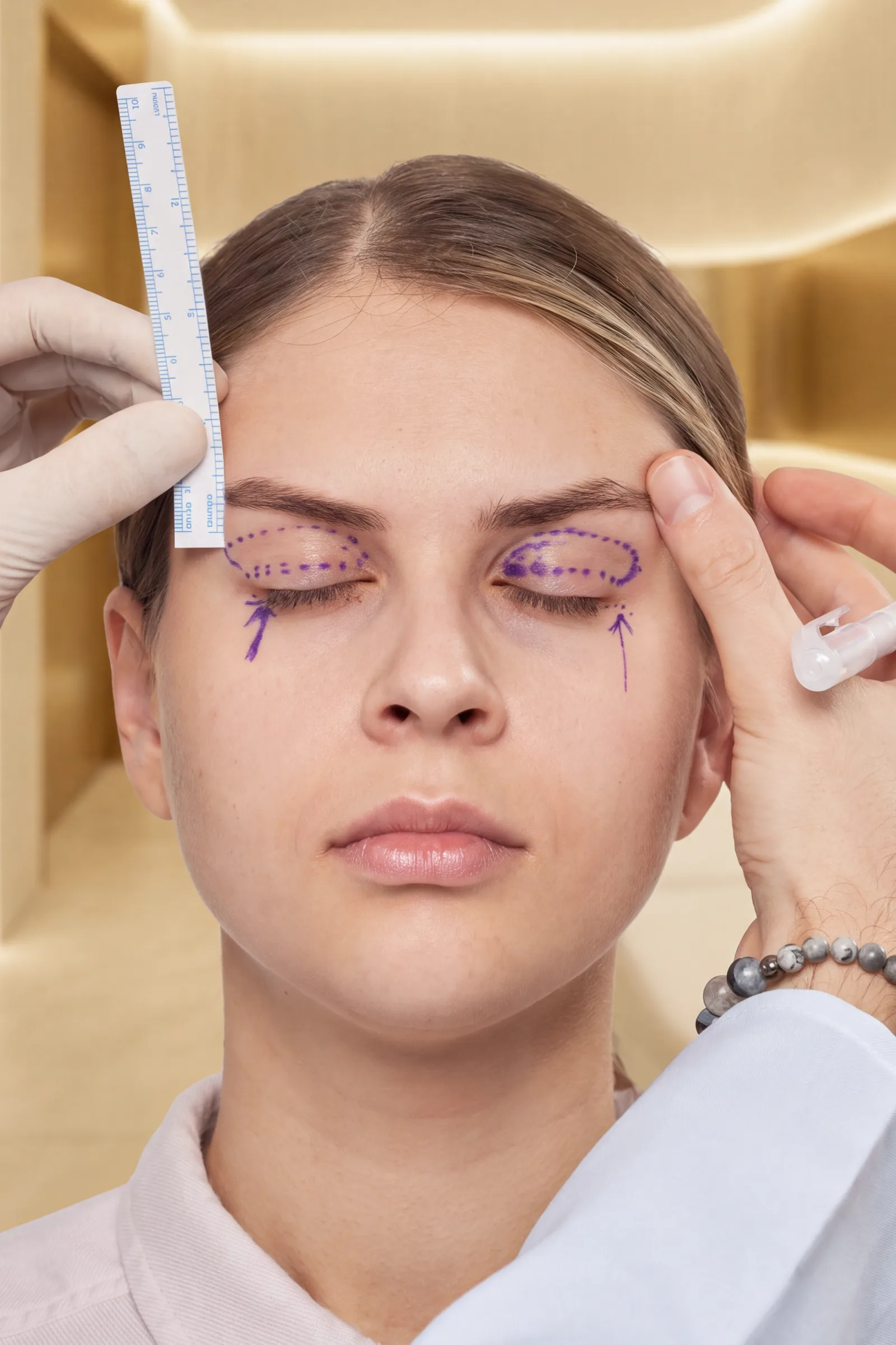
Face Procedure 09 · Blepharoplasty
People read tiredness in the eyes before anywhere else. Eyelid surgery removes the hooding and shadowing that make you look exhausted when you are not — one of the highest-impact procedures relative to its recovery.
Board-Certified Surgeons
DHA-licensed surgical facility
Local Anaesthetic Day Case
Local with sedation, home the same day
Conservative Marking
Measured upright, with your eyes open
Brow Position Assessed
So the right operation is chosen
In Short
Blepharoplasty is eyelid surgery that removes excess skin, muscle and fat from the upper or lower eyelids. Upper blepharoplasty addresses hooding that can weigh on the lashes and in severe cases restrict the field of vision. Lower blepharoplasty addresses under-eye bags caused by fat protruding forward. It is commonly performed under local anaesthetic with sedation, and most patients return to work within five to ten days.
The Procedure
The eyelids age faster than almost any other facial skin, because it is the thinnest on the body and in constant motion. Upper lids develop a fold of excess skin that hoods the eye and, in more advanced cases, rests on the lashes and narrows the upper field of vision. Lower lids develop bags as the fat cushioning the eye pushes forward through a weakening restraining layer.
Blepharoplasty addresses both, and the two are separate operations that can be performed together or independently. Upper lid surgery removes a precisely measured strip of skin, and sometimes a small amount of muscle and fat, through an incision hidden in the natural crease of the lid.
Lower lid surgery is more variable. Where the concern is purely bulging fat with good skin quality, it can be performed entirely from inside the lid — a transconjunctival approach that leaves no external scar at all. Where excess skin also needs removing, a fine incision just beneath the lash line is used instead. Modern practice usually repositions fat to fill the hollow beneath rather than simply removing it.
Techniques & Options
01
Excess skin, and where necessary a small amount of muscle and fat, is removed through an incision concealed in the natural upper lid crease. This is the highest-impact eyelid procedure relative to its short recovery.
02
Under-eye bags are addressed by removing or, more often, repositioning the protruding fat to fill the hollow below it. An incision just beneath the lash line is used only where excess skin also needs removing.
03
Performed entirely through the inside of the lower lid, leaving no external scar whatsoever. It suits younger patients whose concern is bulging fat with skin quality that remains good.
Candidacy
01
Skin excess, fat position, muscle tone, brow height and tear film are all assessed. Brow position matters particularly — a descended brow can create hooding that eyelid surgery alone will not fix.
02
The exact skin to be removed is marked with you sitting upright and eyes open. Over-resection of upper lid skin causes difficulty closing the eye, so this measurement is conservative by design.
03
Usually local anaesthetic with light sedation. You remain comfortable and may be asked to open and close your eyes during the procedure to check symmetry.
04
The marked skin is removed through the crease incision, with a small amount of muscle or fat addressed where indicated, and the incision closed with fine sutures.
05
Fat is repositioned or removed via the transconjunctival or subciliary approach, with skin removed only when genuinely necessary.
06
Cool compresses and elevation for the first days. Stitches are removed at five to seven days and healing is reviewed.
Techniques Compared
Swipe to see more
| Upper Blepharoplasty | Lower Blepharoplasty | |
|---|---|---|
| Addresses | Hooding and excess skin | Under-eye bags and hollows |
| Incision | Hidden in the lid crease | Inside the lid, or beneath the lash line |
| External scar | Concealed in the crease | None with transconjunctival approach |
| Anaesthetic | Local with sedation | Local with sedation |
| Procedure time | 45–60 minutes | 60–90 minutes |
| Bruising | Mild to moderate | More noticeable |
| Back to work | 5–7 days | 7–10 days |
| May improve vision | Yes, where hooding is severe | No |
The Honest View
Eyelid surgery carries risks including bruising, swelling, temporary dry or watery eyes, asymmetry and, uncommonly, difficulty closing the eye fully or a change in lower lid position. It does not treat dark under-eye pigmentation, fine crow's feet or a descended brow — those need different treatments. Ageing continues after surgery, though the improvement is long-lasting. Your surgeon will assess your tear film and brow position and discuss all of this at consultation.
Recovery
Days 1–3
Swelling and bruising peak. Cool compresses and sleeping elevated make a real difference here.
Days 5–7
Stitches removed. Bruising begins to fade and can be covered with makeup from around day seven.
Days 7–10
Most patients return to work. Some residual swelling remains, more noticeable in the mornings.
Weeks 2–4
Swelling largely resolved. Incision lines are pink but settling.
Weeks 4–6
Cleared for full exercise. Scars continue to soften.
Months 2–3
Final result, with incision lines faded to near-invisibility in the upper lid crease.
Google Reviews
Very friendly and professional.
— Alireza Mahmoudian, Verified Google Review
It should not. The aim is to remove excess skin and reposition fat so the eye you already have is properly revealed. A changed eye shape or a surprised appearance is a sign of over-resection, which is precisely why marking is conservative and performed with you sitting upright.
Yes, and it usually is — local anaesthetic with light sedation, as a day case. You remain comfortable and may be asked to open and close your eyes during the procedure so symmetry can be checked directly.
Only partly, and it depends on the cause. If the darkness comes from shadowing cast by a bag or hollow, correcting the contour improves it substantially. If it comes from pigmentation in the skin itself, surgery will not change it and other treatments are more appropriate.
This is the key assessment. If your brow has descended, it pushes tissue down and creates hooding that eyelid surgery alone will not resolve — and removing more lid skin in that situation can make matters worse. Your surgeon measures brow position specifically for this reason.
Upper eyelid surgery is typically long-lasting, with many patients never needing it repeated. Lower eyelid results are also durable. Ageing continues, but you generally continue to look better than you would without the surgery.
Makeup around the eyes from around day seven to ten, once the incisions are fully closed. Contact lenses usually at around two weeks, though this depends on your comfort and dryness.
Yes. When hooding is severe enough to obstruct the upper field of vision, the procedure is functional as well as aesthetic, and visual field testing can document it. That documentation is often what an insurer requires.
At Elora, blepharoplasty starts from AED 12,000. Your exact quote depends on which lids are being treated and the approach your anatomy requires, and is confirmed at your surgical consultation.
A consultation with a board-certified plastic surgeon: your skin excess, fat position, tear film and brow height assessed together, so the right operation is chosen rather than the obvious one.