01
Glandular Excision With Liposuction
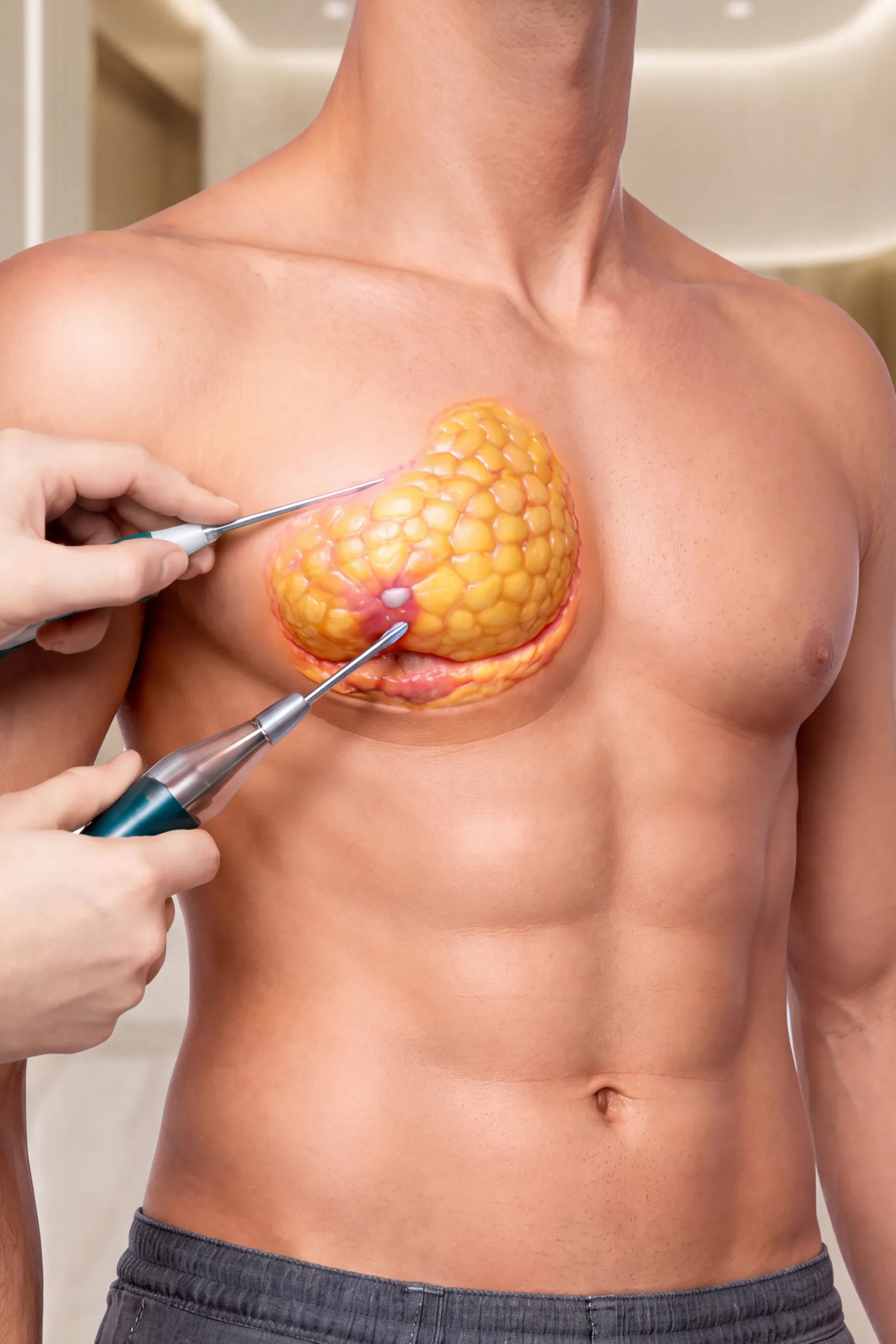
The standard approach for most patients — the gland is removed directly through a small incision at the lower areolar border, and liposuction blends the surrounding chest so there is no visible step or crater.
Body Procedure 07 · Gynecomastia Surgery
Glandular chest tissue does not respond to training, because it is not fat. Surgery removes it — and for most men this is the procedure that changes what they are willing to wear.
Board-Certified Surgeons
DHA-licensed surgical facility
Gland Removed, Not Just Fat
Direct excision combined with liposuction
Concealed Areolar Incision
Scar sits at the lower border of the areola
Day Case Procedure
Back to desk work in five to ten days
In Short
Gynecomastia surgery removes excess glandular breast tissue and fat from the male chest to restore a flat, masculine contour. Because glandular tissue is firm and fibrous rather than fatty, it does not respond to diet or exercise and cannot be removed by liposuction alone — direct surgical excision is required. Most procedures combine excision through a small incision at the lower areolar border with liposuction to blend the surrounding chest. Most patients return to work within five to ten days.
The Procedure
Gynecomastia is the development of glandular breast tissue in men, driven by hormonal factors, certain medications, or occurring without identifiable cause. It is far more common than most patients assume, and its psychological impact is consistently underestimated — many men describe years of avoiding swimming, gyms and fitted shirts.
The clinical point that matters is that glandular tissue is not fat. It is firm, fibrous and sits directly beneath the nipple, which is why it persists in men who are otherwise lean and well trained. Liposuction alone will remove the surrounding fat but leave the disc of gland behind — often making it more prominent rather than less.
Effective surgery therefore almost always combines two techniques: direct excision of the glandular tissue through a small incision along the lower border of the areola, and liposuction of the surrounding chest to blend the result into the chest wall. Excision without blending leaves a crater; liposuction without excision leaves the gland.
Techniques & Options
01
The standard approach for most patients — the gland is removed directly through a small incision at the lower areolar border, and liposuction blends the surrounding chest so there is no visible step or crater.
02
Appropriate where assessment confirms the excess is largely fatty with minimal true glandular tissue, sometimes called pseudogynecomastia. Examination determines which category you fall into, not appearance in a mirror.
03
For more advanced cases, or after substantial weight loss, where excess skin will not retract on its own. This requires additional incisions, which are discussed and marked with you in advance.
Candidacy
01
Your surgeon distinguishes true glandular tissue from fat by examination, and any underlying hormonal or medication cause is investigated before surgery is planned.
02
The balance of excision and liposuction is determined by how much of your chest tissue is glandular versus fatty, and the incision is marked at the lower areolar border.
03
Sedation with local anaesthetic for smaller cases, general anaesthetic for larger or combined procedures.
04
Fatty tissue across the chest and into the axillary fold is removed first, defining the boundaries of the glandular disc that remains.
05
The gland is removed directly through the areolar incision. A thin layer is deliberately left beneath the nipple — removing everything creates a visible depression.
06
A compression vest is fitted immediately and worn for four to six weeks to control swelling and support the new contour.
Techniques Compared
Swipe to see more
| Excision + Liposuction | Liposuction Alone | Training and Diet | |
|---|---|---|---|
| Removes glandular tissue | Yes | No | No |
| Removes surrounding fat | Yes | Yes | Partially |
| Risk of residual disc under nipple | Low | High | N/A |
| Scar | Lower areolar border | 3–5 mm sites | None |
| Suitable for true gynecomastia | Yes | No | No |
| Suitable for fatty chest only | Not needed | Yes | Sometimes |
| Permanence | Permanent | Permanent for fat only | Reversible |
The Honest View
Gynecomastia surgery is a surgical procedure carrying risks including bleeding, haematoma, infection, altered nipple sensation, contour irregularity and asymmetry. A compression vest must be worn for four to six weeks. Recurrence is possible if an underlying hormonal cause or anabolic steroid use is not addressed, which is why investigation comes before surgery. Your surgeon will discuss all of this at consultation.
Recovery
Days 1–3
Swelling and soreness, controlled with prescribed pain relief. The compression vest is worn continuously.
Days 5–10
Most patients return to desk work. Bruising fades and discomfort settles substantially.
Weeks 2–4
Light activity resumes. The compression vest continues; chest and arm training remain off-limits.
Weeks 4–6
Compression is discontinued. Gradual return to full training, chest exercises last.
Months 2–3
Firmness softens and the true chest contour becomes visible.
Months 3–6
Final contour with swelling fully resolved. The areolar scar continues to fade.
Google Reviews
Very friendly and professional.
— Alireza Mahmoudian, Verified Google Review
Because glandular tissue is not fat. It is firm, fibrous tissue that sits directly beneath the nipple and does not respond to caloric deficit or training. Many patients arrive extremely lean and still have a visible disc of gland — which is precisely the diagnostic sign.
The incision sits along the lower border of the areola, where the colour change between areola and chest skin conceals it well. Most patients find it very difficult to see once fully healed. Larger cases requiring skin removal need additional incisions, which are marked and discussed beforehand.
Not if the tissue is properly removed and the underlying cause is addressed. Recurrence is generally associated with continued anabolic steroid use or an untreated hormonal condition, which is why investigation comes before surgery rather than after.
Not always. Smaller cases can be performed under sedation with local anaesthetic as a day case. Larger or combined procedures are performed under general anaesthetic. Your surgeon will recommend based on the extent of your case and your medical profile.
Light lower-body activity at around two weeks, general training from four weeks, and chest and shoulder work last at around six weeks. Returning to chest training too early risks bleeding and contour problems.
Sometimes, where gynecomastia causes documented physical symptoms and an underlying medical cause is established. It depends entirely on your policy, and our team can advise on what documentation your insurer is likely to require.
That is a different condition, sometimes called pseudogynecomastia, and liposuction alone may be appropriate. Examination distinguishes the two reliably — which is why the assessment matters more than what you can judge in a mirror.
A consultation with a board-certified plastic surgeon: examination to distinguish glandular tissue from fat, any underlying cause investigated first, and a clear explanation of what surgery would involve.