Category 06 · Threads
Thread Lift in Dubai
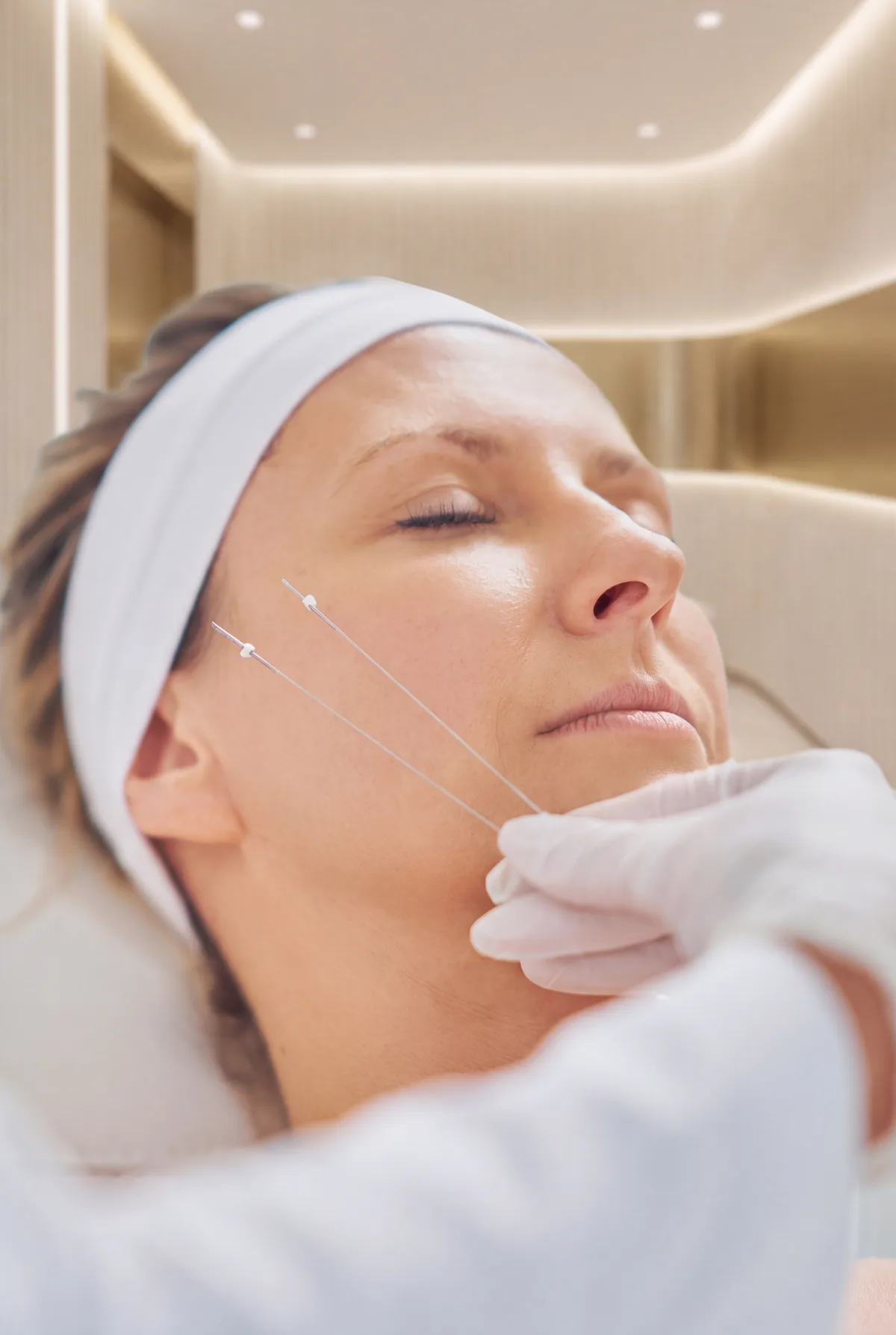
Absorbable threads placed along planned vectors to reposition tissue and stimulate collagen along the way. Modest lifting, real skin improvement, and back to normal life in a day or two.
Aptos & PDO Threads
Matched to area and laxity
No Surgery Required
Local anaesthetic only
Vector-Planned Lifting
Conservative, natural results
Experienced Injectors
Honest suitability assessment
In Short
A thread lift places absorbable sutures beneath the skin along planned vectors to reposition tissue and stimulate collagen. At Elora Polyclinic in Dubai we use Aptos threads and PDO threads, treating the brow, midface, nasolabial folds, jawline and neck. It is performed under local anaesthetic in 45 to 60 minutes with one to three days of downtime. Results typically last 12 to 18 months.
- Treatment time
- 45–60 minutes
- Anaesthetic
- Local
- Downtime
- 1–3 days
- Results visible
- Immediately, settles 2–4 weeks
- Results last
- 12–18 months
The Brands We Use
Products Selected per Area, Not per Clinic
A long-established thread system with a wide range of barbed and mesh designs, allowing the thread type to be matched to the area and the degree of laxity rather than using a single thread everywhere. Aptos threads are our primary system for vector lifting of the midface and jawline.
Polydioxanone threads in several configurations. Cog threads provide mechanical lift; mono and screw threads provide no lift but stimulate collagen in a mesh pattern, used for skin quality and fine crepiness rather than repositioning.
Thread type and vector planning matter more than brand. A barbed thread placed along the wrong vector produces visible distortion when you smile — which is why the planning stage takes longer than the insertion.
Treatment Areas
What Threads Can Treat
Every area is assessed and dosed individually. These are the zones we treat and what each one achieves.
- 01
Brow and Temple
A subtle lift to the outer brow, opening the eye and softening the lateral hooding that ages the upper face.
- 02
Midface and Cheek
The primary vector. Repositions descended cheek tissue upward and outward, which lifts everything beneath it.
- 03
Nasolabial Folds
Softened indirectly by lifting the cheek above them, rather than by filling the crease directly.
- 04
Jawline and Jowls
Redefines the jaw border and lifts early jowling — the most requested thread area at Elora.
- 05
Marionette Area
Lifts the downward pull at the mouth corners that makes the face read as tired or unhappy at rest.
- 06
Neck and Submental
Improves early neck laxity and the submental angle, where surgery would otherwise be the only option.
Where It Is Used
Treatment Areas
Threads are used across the face and neck — brow, midface, nasolabial area, jawline, marionette region and the neck. They are not used on the body at Elora, where skin laxity is better addressed with hyperdilute Radiesse or Profhilo Body.
Candidacy
Is Threads Right for You?
You are likely a good candidate if
- Early to moderate laxity of the jawline, cheeks, brow or neck
- Reasonable skin quality and elasticity remaining
- Wanting improvement without surgery or general anaesthetic
- Typically aged thirty to fifty-five, before significant descent
- Realistic expectations of a subtle, temporary result
This may not be the right treatment if
- Advanced facial descent, where a surgical facelift is the appropriate procedure
- Established heavy jowls or significant neck laxity
- Very thin skin, where threads may be palpable or visible
- Active skin infection or inflammatory condition in the treatment area
- Expecting surgical results without surgery
How Threads Is Performed, Step by Step
01
Honest Suitability Assessment
Your practitioner assesses whether threads will achieve what you want. Where descent is beyond what threads can address, we say so and discuss surgical options instead.
02
Vector Planning and Marking
Vectors are drawn on your face and the thread type selected per area. This stage takes longer than the insertion and determines the entire result.
03
Local Anaesthetic
Entry points and thread paths are numbed. Most patients describe pressure and tugging rather than pain.
04
Thread Insertion
Threads are introduced through entry points concealed in the hairline or natural creases, following the marked vectors.
05
Tissue Repositioning
Barbed threads are gently drawn to reposition tissue. Lift is deliberately conservative — over-tightening produces dimpling and an obviously treated appearance.
06
Aftercare
Avoid facial massage, dental treatment and exaggerated facial movement for two weeks, and sleep on your back to protect thread position while the tissue settles.
Compare
Thread Lift vs Surgical Facelift vs Boosters
Swipe to see more
| Thread Lift | Surgical Facelift | Boosters / Radiesse | |
|---|---|---|---|
| Surgery required | No | Yes | No |
| Anaesthetic | Local | General | Topical |
| Degree of lift | Subtle | Substantial | Minimal |
| Repositions tissue | Yes, modestly | Yes — the deep layer | No |
| Improves skin quality | Yes, via collagen | No | Yes — primary action |
| Result lasts | 12–18 months | 8–15 years | 6–18 months |
| Downtime | 1–3 days | 2–3 weeks | Hours to 3 days |
| Best for | Early to moderate laxity | Advanced descent | Skin quality, mild laxity |
Benefits
Why Patients Choose This Treatment
Benefits
- No surgery, no incisions and no general anaesthetic
- Aptos thread range matched to area and degree of laxity
- Immediate modest lift plus gradual collagen stimulation
- Six treatment areas from brow to neck
- Return to normal activity within one to three days
- Fully absorbable and does not prevent surgery later
What to consider
A thread lift delivers a subtle, temporary result lasting twelve to eighteen months — it is not a substitute for a surgical facelift, and expecting surgical results is the most common cause of disappointment. Bruising, swelling, tenderness and temporary dimpling at entry points are common, and in very thin skin threads may be palpable. Where facial descent is advanced, we will recommend a surgical consultation instead. Your practitioner will tell you honestly whether threads suit your degree of laxity.
Recovery
Your Treatment Timeline
Days 1–3
Swelling, tenderness and possible bruising at entry points. Mild tightness is normal and expected.
Days 4–7
Most patients return to normal social activity. Avoid facial massage and dental treatment.
Weeks 2–4
Initial tightness settles and the result begins to look natural rather than pulled.
Weeks 4–8
Collagen stimulation becomes apparent as improved skin firmness and quality.
Months 6–9
Threads dissolve, but the collagen effect persists beyond them.
Months 12–18
Effect gradually diminishes. Repeat treatment considered at this point.
Google Reviews
Trusted by Patients Across Dubai
Place was friendly and the doctors consult and work amazing. I really was satisfied by choosing this place.
— Maryam Almasi, Verified Google Review
Frequently Asked Questions
How much does a thread lift cost in Dubai?
Thread lifts start from AED 2,500 at Elora. Final pricing depends on how many threads are needed and which areas are treated, confirmed at your complimentary consultation.
Which thread brands do you use?
Aptos threads as our primary system, alongside PDO threads in mono, screw and cog configurations. Aptos offers a wide range of barbed and mesh designs so the thread can be matched to the area and the degree of laxity rather than using one thread everywhere.
Is a thread lift the same as a facelift?
No. A surgical facelift repositions the deep tissue layer and lasts eight to fifteen years. A thread lift provides a subtle lift with dissolvable sutures and lasts twelve to eighteen months. They address different degrees of ageing, and threads cannot produce a surgical result.
How long do results last?
Twelve to eighteen months. The threads themselves dissolve over roughly six to nine months, but the collagen they stimulate persists beyond that, so the effect diminishes gradually rather than disappearing suddenly.
Does it hurt?
Local anaesthetic makes the procedure comfortable. Most patients describe pressure and a tugging sensation rather than pain, with tenderness for a few days afterwards.
Can threads be felt or seen?
Occasionally, particularly in very thin skin. Slight dimpling or puckering at entry points can occur early and usually settles within one to two weeks. Persistent visible irregularity is uncommon and can be addressed.
Who should not have a thread lift?
Anyone with advanced facial descent, established heavy jowls or significant neck laxity — threads will underdeliver, and the money is better spent on a surgical consultation. We would rather decline the booking than have you disappointed at your review.
Related Treatments
Other Treatments You May Be Considering
Lift, Refine & Renew
Book your thread lift consultation today and discover a natural, vector-planned lift — with expert assessment at Elora Polyclinic.