01
Antihelical Fold Reconstruction
Permanent sutures and gentle cartilage scoring recreate the natural fold that is missing or underdeveloped, allowing the upper ear to sit back at a normal angle.
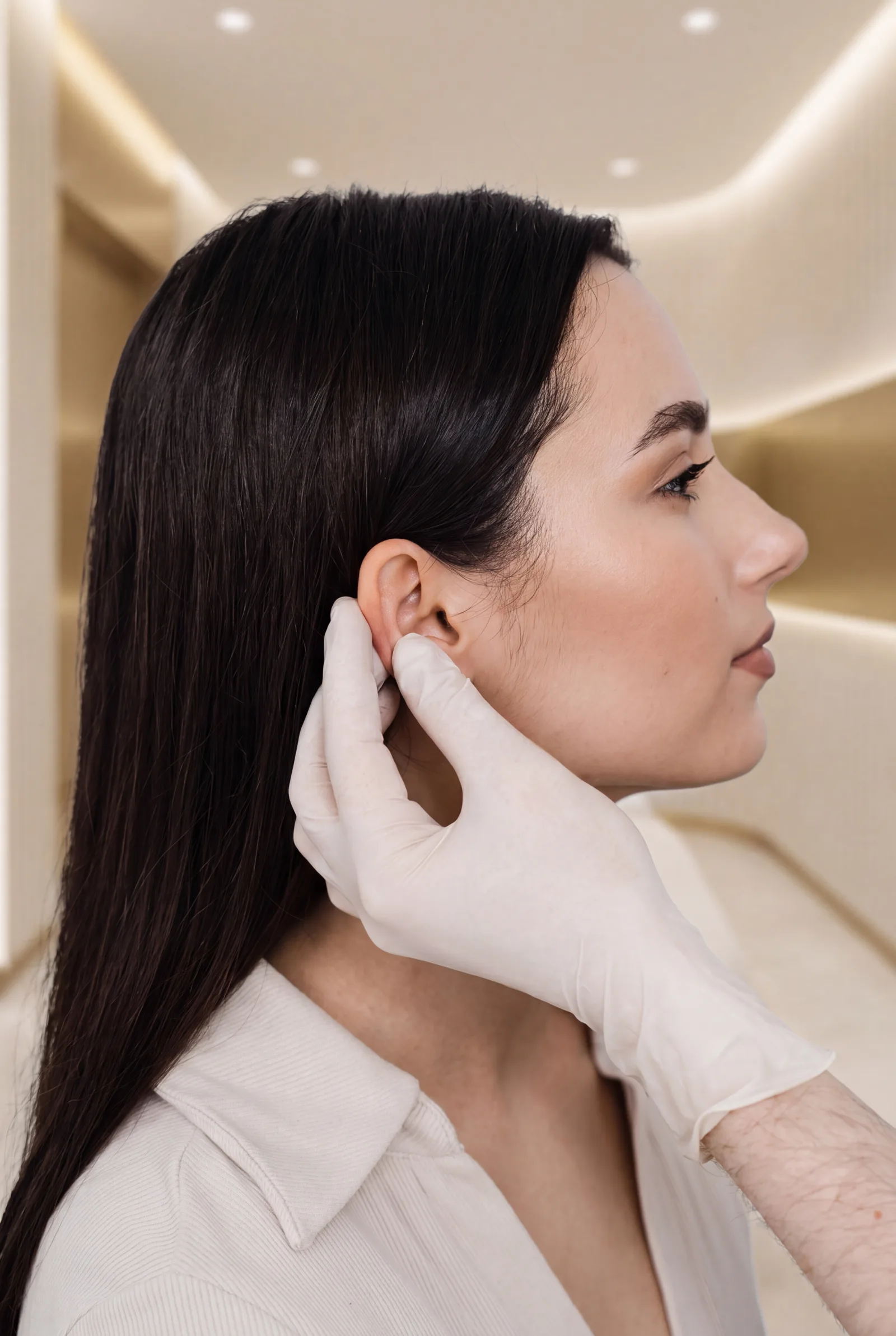
Face Procedure 12 · Otoplasty
Prominent ears are among the few features people spend a lifetime styling around. Otoplasty corrects the underlying cartilage, and the scar sits where nobody will find it.
Board-Certified Surgeons
DHA-licensed surgical facility
Scar Behind the Ear
Placed in the natural crease, effectively invisible
Adults and Children
Suitable from around age five
A Natural Angle
Corrected, not pinned flat against the skull
In Short
Otoplasty is surgery to reshape the ears, most commonly to reduce prominence by recreating the antihelical fold and reducing the conchal bowl. It is performed through an incision hidden in the crease behind the ear, under local anaesthetic in adults and general anaesthetic in children. It can be performed from around age five, once ear growth is largely complete. Most patients return to work or school within five to seven days.
The Procedure
Prominent ears usually result from one of two anatomical features, and often both: an underdeveloped antihelical fold — the natural curved ridge inside the outer rim, which normally folds the ear back toward the head — or an over-deep conchal bowl, the cup-shaped hollow that pushes the whole ear outward.
Otoplasty corrects whichever applies. Through an incision hidden in the crease behind the ear, the cartilage is scored, sutured or partially removed to recreate the missing fold and reduce conchal depth. The aim is a natural-looking ear that sits at a normal angle, not one pinned flat against the skull, which looks operated on from every angle.
It is one of the few aesthetic procedures routinely performed in children, generally from around age five once ear growth is largely complete — often before school-age teasing begins. In adults it is a day case under local anaesthetic, and a significant proportion of adult patients say they considered it for decades before booking.
Techniques & Options
01
Permanent sutures and gentle cartilage scoring recreate the natural fold that is missing or underdeveloped, allowing the upper ear to sit back at a normal angle.
02
Where the conchal bowl is too deep and pushes the whole ear outward, cartilage is reduced or repositioned to bring the ear closer to the head at its base.
03
Most patients need both techniques together to achieve a natural result. Revision otoplasty corrects previous over-correction, asymmetry or recurrence, and is planned more conservatively.
Candidacy
01
The degree of prominence is measured at the top, middle and bottom of the ear, and asymmetry between sides documented. Correction is planned to leave a natural angle, not a flat one.
02
Whether the correction requires fold reconstruction, conchal reduction or both is decided from your specific cartilage anatomy.
03
Local anaesthetic for adults as a day case. General anaesthetic for children, also as a day case.
04
Through the incision behind the ear, cartilage is scored and shaped, and permanent sutures create and hold the new fold.
05
Both ears are compared directly from the front and above before closure. Perfect symmetry is not achievable in any ear, and the aim is a natural match rather than a mirror image.
06
A supportive dressing is applied for the first week, followed by a soft headband worn at night for several weeks to protect the correction while it heals.
Techniques Compared
Swipe to see more
| Otoplasty | Ear Moulding (Infants) | Non-Surgical 'Thread' Methods | |
|---|---|---|---|
| Suitable age | 5 years and above | First weeks of life only | Adults |
| Corrects cartilage shape | Yes | Yes, while cartilage is soft | Limited |
| Permanence | Permanent | Permanent if started early enough | Frequently relapses |
| Anaesthetic | Local or general | None | Local |
| Scar | Hidden behind the ear | None | Minimal |
| Evidence base | Well established | Well established in newborns | Limited |
| Recovery | 5–7 days | None | 2–3 days |
The Honest View
Otoplasty carries risks including bleeding, haematoma, infection of the cartilage, asymmetry, suture extrusion and partial recurrence of prominence. A protective headband must be worn at night for several weeks. Perfect symmetry between ears is not achievable — no natural ears are identical — and the aim is a natural match. Your surgeon will discuss all of this, and for children will want to be satisfied that the child wants the procedure themselves.
Recovery
Days 1–7
Supportive dressing worn continuously. Sleeping on your back is essential. Some throbbing is normal.
Day 7
Dressing removed and the ears reviewed. Swelling and bruising still present at this stage.
Weeks 1–2
Most patients return to work or school. Soft headband worn at night from this point.
Weeks 2–6
Headband continues at night. Contact sports and swimming remain restricted.
Weeks 6–8
Cleared for full activity, including sport.
Months 2–3
Final settled position, with the scar behind the ear fading to near-invisibility.
Google Reviews
Very friendly and professional.
— Alireza Mahmoudian, Verified Google Review
Generally from around age five, once ear growth is largely complete. Many families choose to have it done before or early in school years. Most importantly, the child should want it — motivation coming solely from a parent is a reason to wait rather than to proceed.
In the natural crease behind the ear, where it is effectively invisible in normal life. Even with hair tied back or cut short, patients rarely find it noticeable once healed.
Not if the correction is planned properly. The aim is a natural angle with the antihelical fold restored, not ears flattened against the skull. Over-correction is a recognised aesthetic error and looks obviously operated on from behind.
There is throbbing discomfort for the first two to three days, generally managed with simple pain relief. The dressing feels tight, and most patients find that more irritating than actual pain.
Partial recurrence is possible, particularly if the protective headband is not worn as instructed during the early weeks. Properly performed and properly protected, the correction is durable long term.
Yes, and it matters. A supportive dressing for the first week and then a soft headband at night for several weeks protects the correction while the cartilage settles. Compliance in this period materially affects the durability of the result.
Yes, and it is common where asymmetry is the concern. Your surgeon will assess whether operating on one side achieves a natural match, or whether a smaller adjustment to the other side gives a better overall balance.
A consultation with a board-certified plastic surgeon: prominence measured at every level of the ear, asymmetry documented, and an honest conversation about what correction your cartilage anatomy requires.