01
Facial Volume Restoration
Used in the cheeks, temples and nasolabial folds to restore softness and volume where a fully natural approach is preferred. The effect is softer than a hyaluronic acid filler by nature.
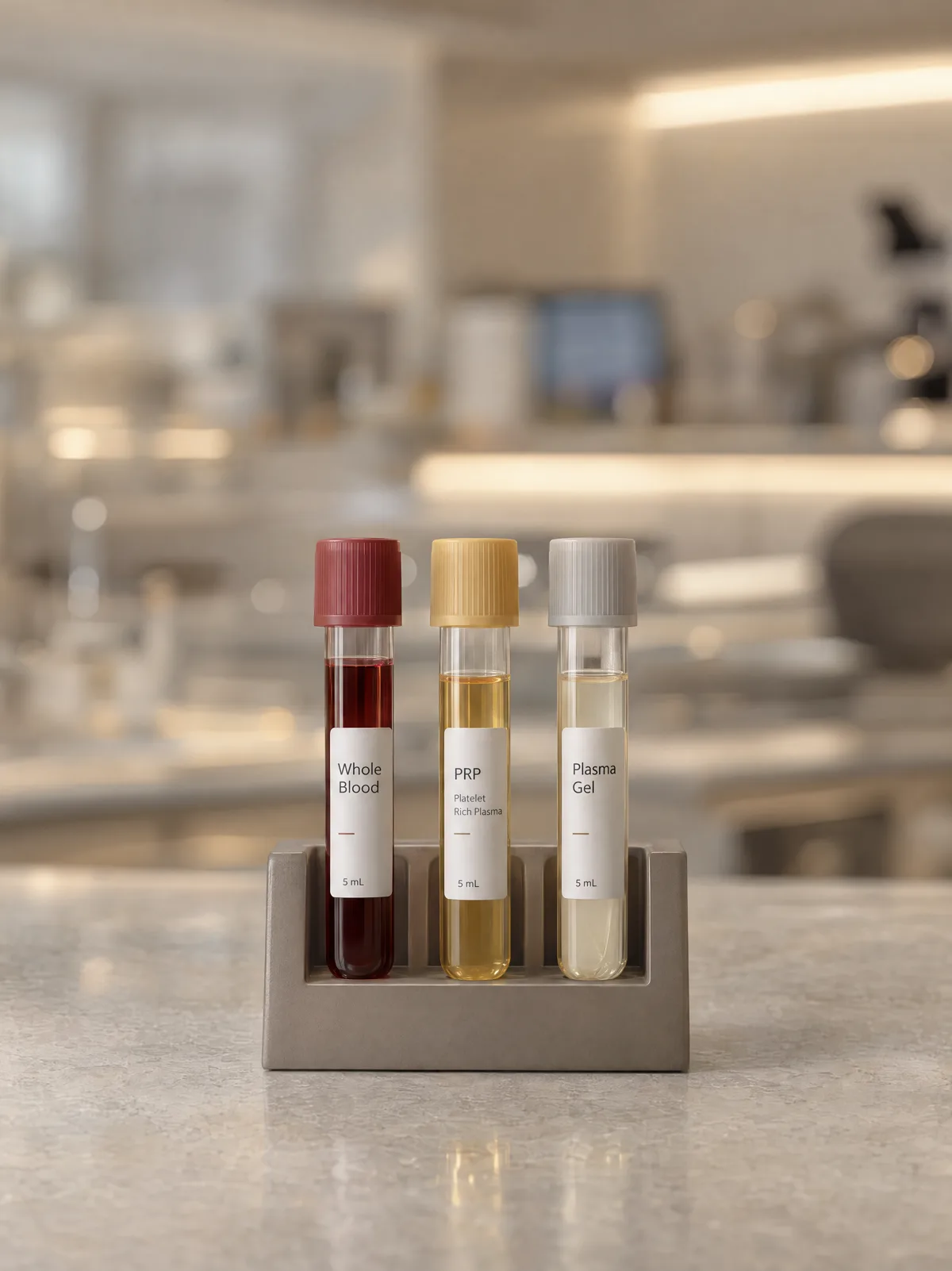
Category 04 · Plasma Gel
Your own blood plasma, heated and processed into a gel, then used exactly as a filler would be. No synthetic material, no allergy risk, and nothing in your face that did not come out of your arm.
Your Own Plasma
No synthetic material, no allergy risk
Works Like a Filler
Injected in the same planes as HA filler
Under-Eye Suited
Where synthetic filler is unforgiving
Pairs With PRP
Volume and skin quality in one visit
In Short
Plasma gel is an autologous filler made from your own blood. Plasma is separated by centrifuge and then heated, which causes its proteins to coagulate into a soft gel that can be injected exactly as a dermal filler would be. Because it comes entirely from your own body there is no synthetic material and no allergy risk. Results last approximately four to eight months. At Elora Polyclinic in Dubai it is used for facial volume, nasolabial folds, tear troughs and overall skin quality.
Where It Is Used
Plasma gel is used primarily on the face — cheeks, temples, nasolabial folds and tear troughs — and can also be used on the neck and the back of the hands. It is not used for body contouring, where the volume required would be impractical.
Options
01
Used in the cheeks, temples and nasolabial folds to restore softness and volume where a fully natural approach is preferred. The effect is softer than a hyaluronic acid filler by nature.
02
Its soft consistency and complete biocompatibility make it well suited to the under-eye area, where synthetic products can be technically demanding and unforgiving.
03
Frequently performed alongside PRP in the same appointment — the gel restores volume while the liquid plasma fraction is used to stimulate skin quality across the wider face.
Candidacy
01
Volume loss is assessed and suitability confirmed, including any blood conditions or medication affecting clotting.
02
A sample is taken — a larger volume than for PRP, since gel yield is lower than liquid plasma yield.
03
The sample is spun to separate plasma from cellular components, performed on site while topical anaesthetic takes effect.
04
Plasma is heated under controlled conditions until its proteins coagulate into a soft gel, then cooled and drawn into syringes.
05
Placed with a needle or cannula in the same planes a hyaluronic acid filler would occupy, and moulded for smooth distribution.
06
Assessed at four weeks once swelling has fully settled. Repeat treatment is often planned at four to six months.
Compare
Swipe to see more
| Plasma Gel | HA Filler | PRP | |
|---|---|---|---|
| Material | Your own plasma | Synthetic HA gel | Your own plasma |
| Adds volume | Yes, softly | Yes | No |
| Allergy risk | None | Very low | None |
| Blood draw needed | Yes | No | Yes |
| Structural lift | Limited | Strong | None |
| Reversible | Absorbs naturally | Yes — dissolvable | N/A |
| Lasts | 4–8 months | 9–18 months | Effect 9–12 months |
| Best for | Natural soft volume | Defined contour | Skin quality |
Benefits
Plasma gel lasts four to eight months, which is shorter than hyaluronic acid filler, and its soft consistency cannot achieve the sharp structural definition a firm filler provides on the chin or jawline. It requires a blood draw at each session, and yield varies between individuals. Swelling and bruising for one to three days are normal. It is not suitable with certain blood disorders or anticoagulant therapy without medical clearance. Your practitioner will discuss all of this at consultation.
Recovery
Days 1–3
Swelling and possible bruising at treated areas. Avoid heat, exercise and pressure on the face.
Days 4–7
Swelling settles and the true volume result becomes visible.
Weeks 2–4
Result stabilises. This is when the outcome should be judged, not before.
Months 1–3
Stable result, with skin quality benefit from the plasma proteins alongside the volume.
Months 4–6
Gradual absorption begins.
Months 4–8
Repeat treatment considered to maintain the result.
Google Reviews
Place was friendly and the doctors consult and work amazing. I really was satisfied by choosing this place.
— Maryam Almasi, Verified Google Review
They start identically — both come from your own centrifuged blood. PRP is a liquid injected to stimulate repair and skin quality. Plasma gel is heated so its proteins coagulate into a gel, which is then used to restore volume like a filler. Different form, different purpose, same source.
Four to eight months, which is shorter than a hyaluronic acid filler. That is the trade-off for a completely natural material with no synthetic component.
It removes allergy and hypersensitivity risk entirely because the material is your own. Injection risks common to any filler still apply, so technique and practitioner training matter just as much.
Yes, and its softness and complete biocompatibility make it well suited there. The under-eye remains a technically demanding area regardless of product, and suitability is assessed individually.
Not really, and this is worth being clear about. Plasma gel is soft by nature and cannot produce the sharp structural definition a firm hyaluronic acid filler or Radiesse achieves. For jawline definition those are the appropriate products.
Yes, and it is a common combination in a single appointment — the gel restores volume while the liquid plasma fraction treats skin quality across the wider face.
Related Treatments
Book your plasma gel consultation today and discover volume restoration using nothing but your own blood plasma — with expert assessment at Elora Polyclinic.